
Updated: 13 October 2026
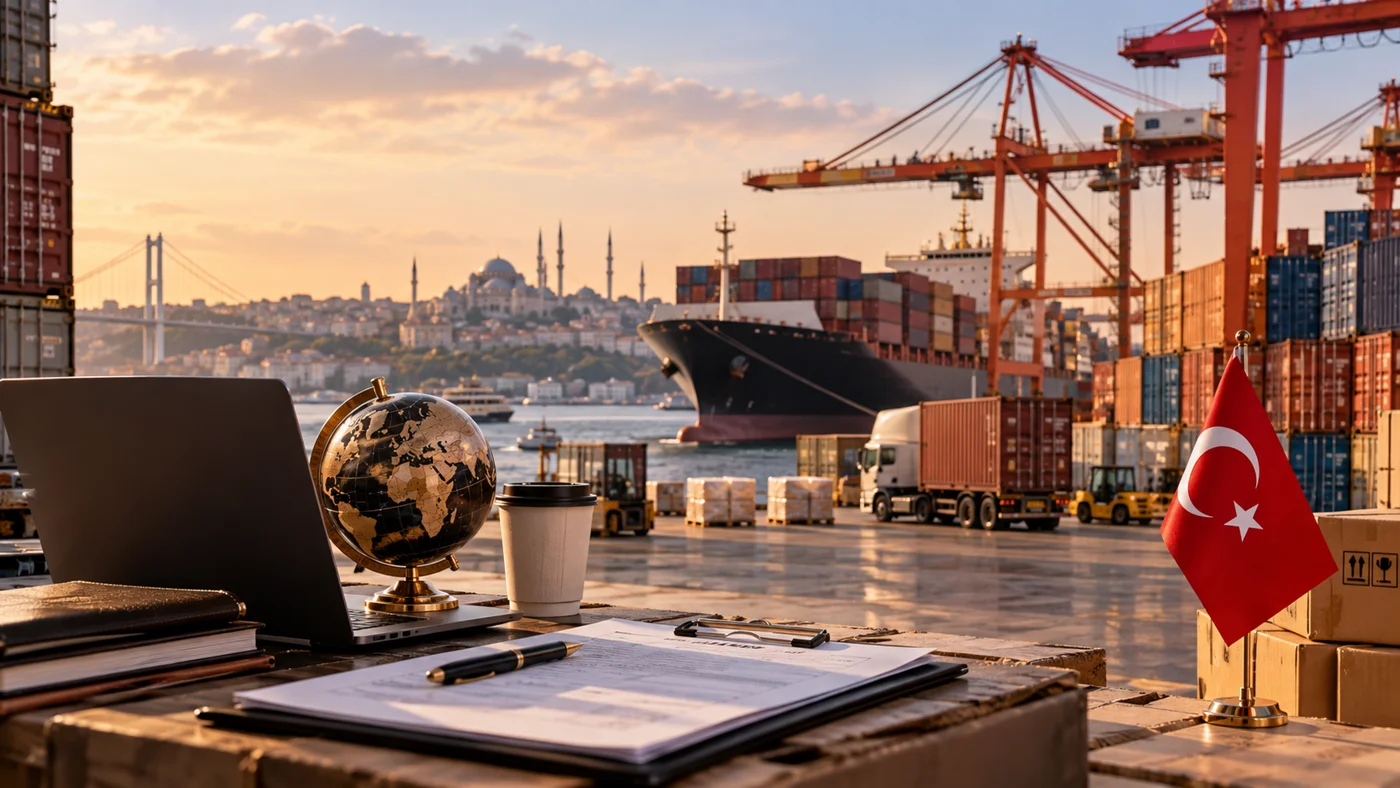
Situated between Europe, Asia and the Middle East, Türkiye is one of the region’s major international trade centres. Many Iranian and Persian-speaking entrepreneurs source goods, raw materials and industrial machinery from Türkiye or use it as a base for reaching European and neighbouring markets. Success requires a sound understanding of customs rules, documentation and available public support.
In this guide, VALA Business Academy explains the main stages of importing and exporting in Türkiye, drawing on official Ministry of Trade information and the relevant regulatory framework.
Why consider Türkiye for international trade?
- Customs Union with the EU: Industrial goods within its scope and in free circulation can benefit from customs duty arrangements when traded with the EU, subject to A.TR documentation and applicable conditions. A.TR is not proof of origin; trade defence measures and other taxes still need to be checked.
- Free and preferential trade agreements: Lower tariffs may be available when the agreement’s origin rules are met and the appropriate evidence is provided, such as EUR.1 or another document required by the particular agreement.
- Free zones: These have a special status for certain customs and tax purposes. Benefits depend on the activity and legal conditions; sales into the Turkish domestic market may trigger normal import obligations.
- Digital customs infrastructure: Customs declarations are submitted electronically, with many processes handled through the Ministry’s online systems.
Who can import and export in Türkiye?
Under the Import Regime Decision, individuals and legal entities with a tax number may conduct imports subject to applicable requirements. For regular commercial activity, establishing a company or arranging the appropriate tax registration is an initial step. Specific import transactions have exceptions to the tax-number requirement.
For ordinary commercial exports, membership of the relevant sector’s exporters’ association and the prescribed payments are the general rule. Exceptions exist for certain transactions; confirm the membership requirement, appropriate association and fees for your particular operation.
The main stages of importing into Türkiye

1. Identify the customs classification: GTİP
Correct classification under Türkiye’s Customs Tariff Statistical Position, known as GTİP, is essential before importing. It determines the relevant taxes, permits and controls. The current Turkish Customs Tariff can be consulted through the Ministry of Trade’s Directorate General of Customs.
2. Check permits, standards and restrictions
Depending on the product, prohibitions, permits, quotas, health certificates, test reports, CE conformity or surveillance documents may apply. For example:
- Used, refurbished or defective goods, including used machinery, fall under the Directorate General of Imports’ permit framework. Check the procedure against the GTİP and current communiqué.
- Medicines, animal and agricultural products, chemicals and vehicles may be subject to controls by specialist authorities.
- Many consumer and industrial products are assessed for safety and technical conformity through the Risk-Based Trade Control System, TAREKS.
3. Declare the goods and complete customs clearance
Where required, the carrier or other authorised responsible party submits a summary declaration before arrival. Goods are presented to customs and remain in temporary storage until assigned a customs-approved treatment or use. For definitive imports, an electronic declaration for release into free circulation is submitted. Prepare the commercial invoice, transport document, origin evidence where required and relevant permits. These procedures are commonly handled with a licensed customs broker.
4. Calculate duties and other charges
Costs depend on GTİP, origin, customs value and the applicable regime. Customs duty, additional customs duty on certain goods, VAT (KDV) and special consumption tax (ÖTV) for particular products may apply. Check any further product-specific charges or trade policy measures. Goods enter free circulation once the required payments and formalities are completed.
The main stages of exporting from Türkiye

- Arrange suitable tax registration and, where appropriate, company formation; check exporters’ association membership requirements.
- Select a destination and research the market. The Ministry of Trade’s Kolay İhracat platform offers information and market guidance.
- Review destination-country requirements and export controls. Products requiring prior permission, mandatory standards or quality checks follow specific procedures.
- Prepare the invoice, packing list and required origin or movement documents. A.TR and EUR.1 serve different purposes; the appropriate document depends on the product and destination.
- Submit the export declaration and complete exit formalities. Actual export occurs when the goods leave Türkiye’s Customs Territory while retaining their declared condition and characteristics.
E-commerce exports and small consignments: Micro-exporting
Small businesses and online stores may export eligible consignments within the current weight and value limits using simplified customs declarations through authorised postal or express operators. Eligibility, permits and restrictions must be checked product by product; a low shipment value alone is not enough.
Public incentives and support for foreign trade
A significant portion of Türkiye’s export support operates under Decision No. 5973 on Export Supports and its implementing circulars. Export finance, insurance and e-commerce exports also have their own programmes and rules. Major areas include:
- Participation in domestic and international trade fairs;
- Overseas market research and market-entry reports;
- Certificates and documents required for market entry;
- Overseas trademark registration and the TURQUALITY® branding programme;
- Design, product development, trade delegations and UR-GE cooperation projects;
- Export finance and insurance through Türk Eximbank;
- Dedicated e-commerce export support.
Support is not automatic. Review eligibility, application timing, documentation and prior-approval requirements before incurring costs.
The inward processing regime: Dahilde İşleme
This regime provides conditional relief or repayment mechanisms for inputs used in export production. Conditions can include authorisation, guarantees and completion of export commitments within the required period. Applications follow the relevant permit or certificate procedure through the Ministry’s Support Management System (DYS) and competent authorities.
Free zones: Serbest Bölgeler
Türkiye’s free zones offer specified customs and tax advantages for export-oriented production and trade. Treatment of overseas sourcing and deliveries of goods or services from Türkiye depends on the transaction and applicable rules. Profits from products manufactured in a free zone and sold abroad, within the same zone or to other free zones may qualify for income or corporate tax exemption under current legal conditions. Domestic Turkish sales and profits from trading alone do not automatically qualify for the same exemption.
Iran–Türkiye trade: Points for Iranian entrepreneurs
The preferential trade agreement between Iran and Türkiye provides reduced tariffs for specified product lists. To benefit, the goods must be covered and their origin demonstrated using the documentation required by the agreement. Before signing a contract, carefully review payment arrangements, banking requirements and any international rules applicable to the goods.
Common import and export mistakes
- Using the wrong GTİP and miscalculating taxes or exposing the transaction to penalties;
- Buying goods before checking permits and standards;
- Differences between the actual goods and the declared type, quantity or value;
- Overlooking origin evidence and losing preferential tariff treatment;
- Learning about support too late to apply for eligible expenditure.
VALA’s import and export services
With specialists experienced in Turkish commercial law and international trade, VALA Business Academy provides guidance from its office in Şişli, Istanbul, including:
- Trading company formation and tax registration advice;
- Target-market analysis and identification of export opportunities;
- Finding and assessing Turkish suppliers of goods, raw materials and industrial machinery;
- GTİP, permit and document reviews in cooperation with licensed customs brokers;
- Commercial contract review and trade law advice;
- Guidance on export incentives and public support.
Frequently asked questions
Must I establish a company to import into Türkiye?
A tax number is the general requirement for ordinary commercial imports; qualifying individuals may also import. A company can be appropriate for ongoing business. Specific exceptions should be assessed separately.
Is exporters’ association membership mandatory?
Generally yes for ordinary commercial exports. Exceptions exist for certain goods and transactions, so confirm the position for your shipment.
Can I import used machinery into Türkiye?
Used goods fall under a permit framework. Review the machinery’s GTİP, technical specifications and current communiqué requirements before buying.
How do I calculate customs costs?
First establish GTİP, then assess taxes and other obligations according to origin, customs value and regime. Advice before purchasing can help reduce unexpected costs.
Build your trade plans on sound foundations
Importing and exporting in Türkiye can support business growth when regulations, documents and incentives are understood correctly. If you plan to source goods, export products or establish a trading company in Istanbul, VALA’s specialists can guide you from the initial planning stages through customs procedures.
Request an import and export consultation through our Contact page.